

Winter on the Farm
Wednesday, January 14th, 9:30AM -11:00AM
Wednesday, December 10th, 9:30AM – 10:300AM
.
Come, let us travel back 130 years or so, to the time before automobiles. Now, imagine walking down a snowy street. The walkways are tramped down by previous passer-by. The road is turned and churned by horse hooves and sleigh runners. The air is crisp and cool, holding the promise of more snow fall. The shops are lit from within, scattered bits of conversation leaking out when doors are opened. And tinkling chimes are heard all around; the chimes of sleigh bells. Bells heralding the coming of a magnificent sleigh, carrying joyous folk and proud horses tacked with the ringing bells.
Bells have various uses and purposes and are as old as time; or at least as old as bronze. An early bell shape is similar to that of cow bells you may have seen around. They were shaped like a four-sided pyramid, or quadrangular. They were made of two plates of iron that were bent to form a corner each and then pieced together with iron rivets and coated in bronze (Hatch 13). There is an example of one such bell held at the National Museum of Ireland, known as the Clog-an-eadhacta Phatraic or “The Bell of the Will of St. Patrick.” The legend of the bell is that the sound was so frightful that no snake would have remained in Ireland to listen to the racket St. Patrick would have been making with his Clog-an-eadhacta; especially if they were akin to snakes of oriental origin that were addicted to sweet sounding flute music (Hatch 14).
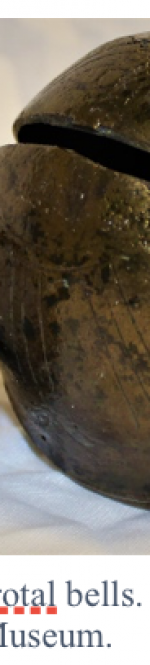
Alas, we have digressed from the topic of this post; sleigh bells. Sleigh bells have a different origin, and little has changed from the first. What we call a sleigh bell was first known as a Crotal. Spherical in shape with small holes and a ball inside. The ball was once made of stone but is more commonly metal today (Hatch 15). Eric Hatch, in his book The Little Book of Bells, notes the longevity and purity of the Crotal bell:
“The Crotal is a true bell form and is the most ancient of all forms. The marked resemblance between the ancient and modern Crotal is extraordinary. I cannot think of any other object that was created thousands of years ago in a form so perfect that no one since has been able to find a way of improving it.” (15)
Sleigh bells have had many uses in the past and in modern times. They became a symbol of status and wealth; decorations on horse harnesses ad tack to display the wealth of the owner. They were also viewed as good luck charms and wards against evil, disease, and injury. They also served as a warning to pedestrians and other travelers. The bells gave an obvious and early warning that there was an oncoming sleigh, giving time for people to get out of the sleigh’s path. This was important because sleighs were not able to stop quickly, so listening for the bells was a matter of safety. Vendors using horse drawn conveyances also used bells to signal they were in the area, much like a modern ice cream truck.
Songs such as Jingle Bells and Sleigh Ride use sleigh bells for lyrics as well as instruments for the song. James Lord Pierpont compose One Horse Open Sleigh, more commonly known as Jingle Bells, in 1857. The chorus of the song an example of onomatopoeia, “Jingle bells, jingle bells, jingle all the way,” is one show case of sleigh bells and their sound. Jingle Bells is making use of the bell sounds to demonstrate the joy and cheer that the sound brings in the wintertime. Sleigh Ride also uses sleigh bell sounds in the lyrics, “Ring tingle tingling too.” Sleigh Ride is using the sound of the bells to keep a couple ensconced on their sleigh ride, alone but for each other. Another classic winter song with sleigh bells is, Winter Wonderland. Here the lyrics prompt for walkers to listen for the sound of the bells. This first line, “Sleigh bells ring, are you listening?” sets the scene and mood for the walkers, prompting happiness; but it is also a nod to listen for the warning of an oncoming sleigh.
In the year 2020, 36 cultural institutions from every corner of Vermont will collaborate on a suite of exhibitions and events on the theme 2020 Vision: Seeing the World Through Technology. Billings Farm & Museum will be participating through an installment of Windows to the Past and a Machine of the Month blog posting. Check in regularly for updates and details on what we have to offer!
Works Cited
Hatch, Eric. The Little Book of Bells. First ed., Duell, Sloan, & Pearce, 1964.
You can explore the “charming” downtown of Woodstock and visit the historic Billings Farm and Museum, established in 1871, where guests can view displays of a traditional 1800s Thanksgiving celebration, according to the Vermont Department of Tourism & Marketing. Before you go, read the museum’s COVID-19 safety guidelines and Vermont’s COVID-19 travel restrictions.
Do you hear what I hear? Sleighbells jingling… reindeer hooves clacking… Santa Claus. All the sounds of the season are coming to Billings Farm & Museum beginning this weekend.
The holiday traditions of 19th century New England will engulf the farm in Woodstock, Vt. with Christmas at the Farm celebrations and themed activities to be held on weekends throughout December (Dec. 5, 6, 11, 12 and 13), and then daily from Dec. 19 to Jan. 3, 2021 (excluding Christmas Day), 10 a.m. to 4 p.m.
An authentically decorated farmhouse parlor will transport visitors to Victorian times, where they can enjoy holiday stories. Candle-dipping and cooking demonstrations of various holiday foods and gingerbread offer a full traditional experience.
Visitors are encouraged to bundle up and take to the farm fields, too, with snowshoes. It’s a traditional pastime, and one that is perfectly suited for the region. Bring your own snowshoes or borrow some from Billings. Later, warm up with a cup of wassail (hot mulled cider) and homemade cider donuts.
Billings’ holiday celebrations will feature online components this year, including a baking/cooking demonstration and workshop with Chef Emery. On Dec. 5 (10 a.m. to 2 p.m.), learn how to make holiday cookies and teas. Chef Emery will make two different types of each, using local dried herbs and fruits as well as local jams.
The Woodstock Vermont Film Series is streaming several documentaries online: “Once Were Brothers: Robbie Robertson and The Band” (Dec. 3 to 6); “The Last Ice” (Dec. 17 to 20); and “The Woman Who Loves Giraffes” (Dec. 31 to Jan. 3, 2021). Travel the world with these films, all without leaving your living room.
December will also be a time for some additional education, courtesy of Billings Farm. Owned and operated by the nonprofit Woodstock Foundation Inc., Billings offers a lot of educational opportunities at the farm and now online.
Family Wednesdays target students who are learning remotely. Each week throughout the month will focus on a different farm theme. Learn more about the animals, see objects from the museum’s various collections, learn some crafts at home, hear stories read aloud and more. Chickens will be the focus on Dec. 2; Draft Animal Power on Dec. 9; and Giddy Goats on Dec. 16.
As January and February are Vermont’s two bitterest and coldest months, this blog post is focused on the technology and tools of ice cutting.
Winter has settled in and still has weeks before it lets go to warmer weather. Farmers are idle without fields to tend, or are they? In Vermont and the northeastern areas of the United States, farmers found a field that could be harvested during the coldest months, at least until refrigerators and freezers came to be.
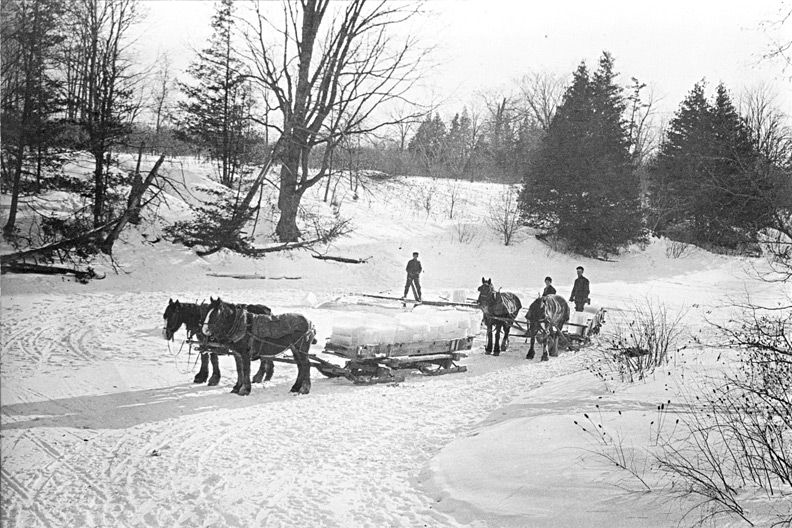
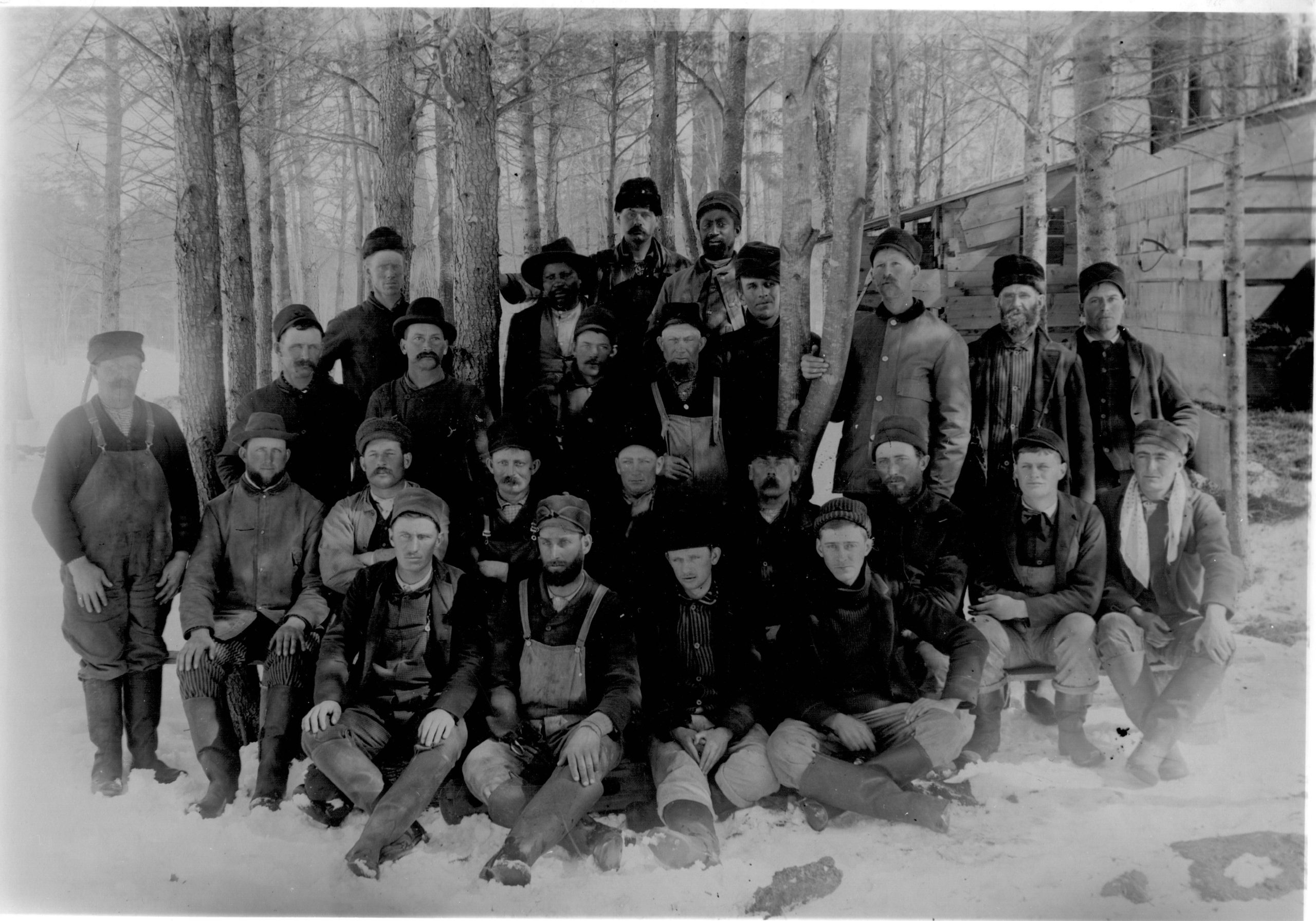
The Billings Estate in the late 1800s had its own icehouse and access to a fresh water source; The Pogue on Mt. Tom. The farmers that tended the fields spring to fall, found another field to harvest during January and February. The ice that The Pogue produced was in their back yard and a downhill trip to the icehouse for storage. The crew that worked The Pogue harvesting process numbered 20-30 men and used teams of horses from the farm. The icehouse doubled as a storage space for the harvested ice and had a smaller room that stored could be used for cool storage for products, such as the butter made by the farm.
Before even contemplating a harvest, the ice needed to be thick enough: 2 inches of ice can support a man, 4 inches are necessary to support a horse, and 5 inches to support a horse and equipment (Seavey, 2016). Ten to fourteen inches of ice was optimal for harvesting; regular ice depth measurements were taken of the ice field by using an auger to drill a hole and inserting a measuring rod with graduated markings.
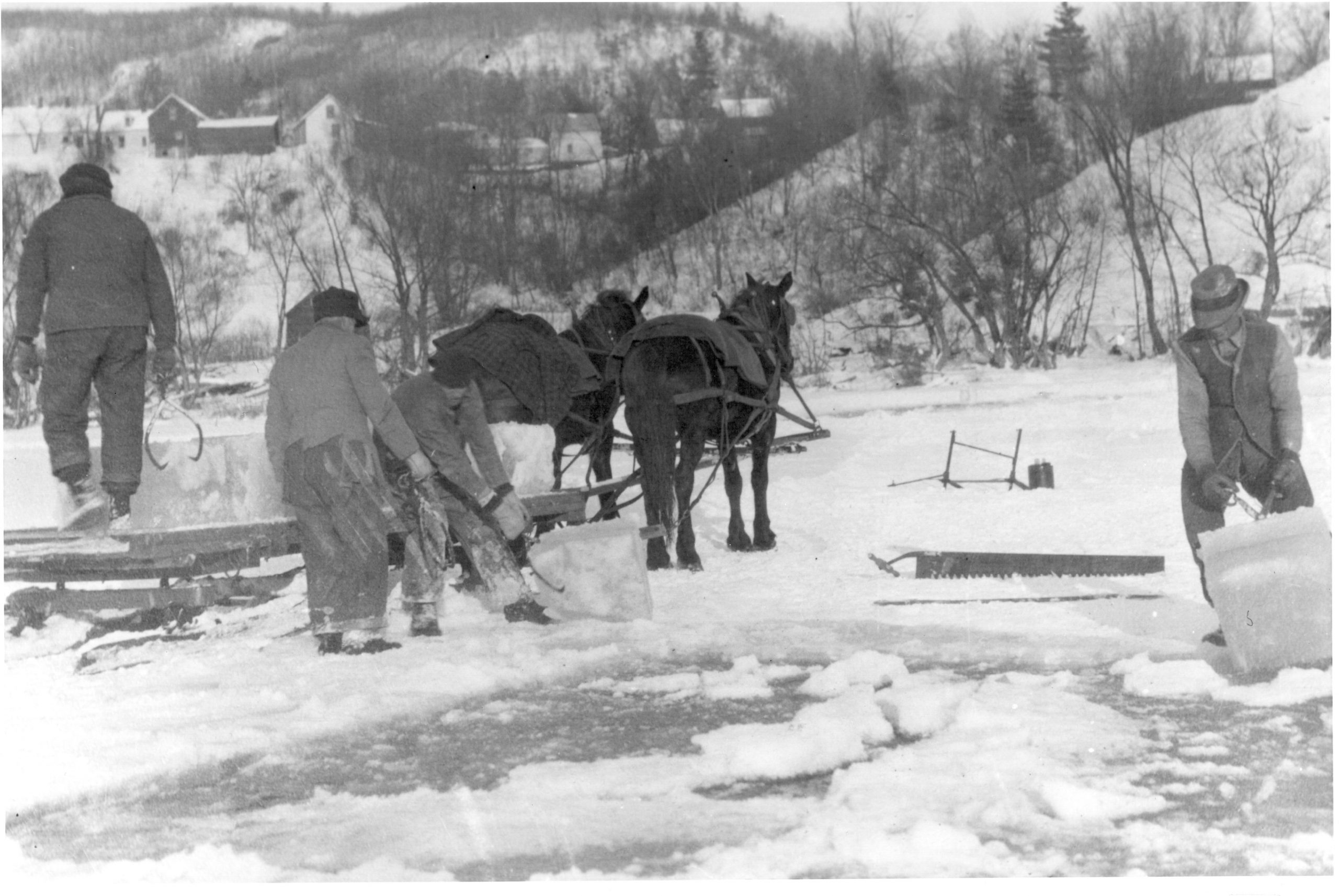
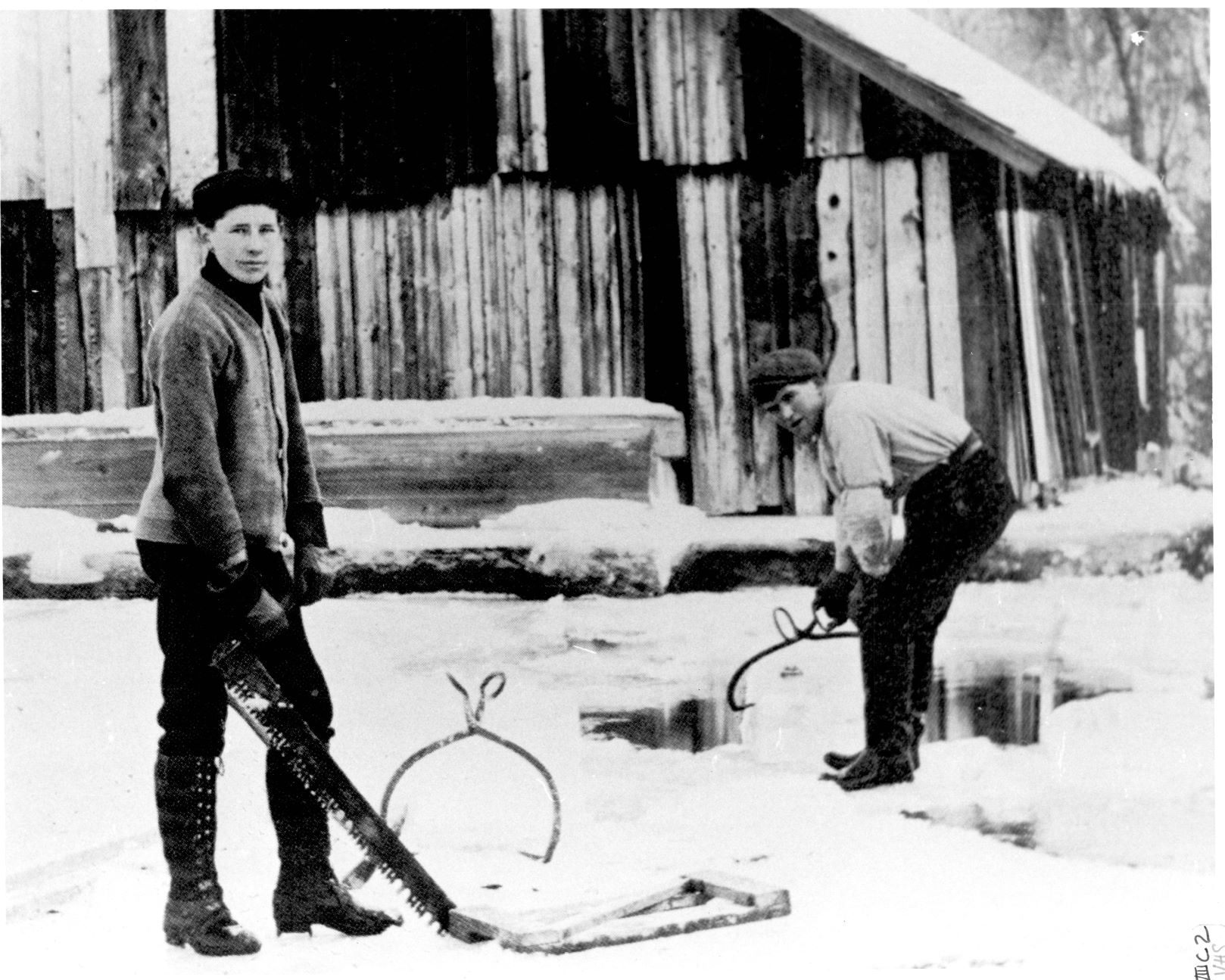
Once the harvest got underway, there were a few key pieces of equipment that the men used. Ice saws were used to hand cut the ice in to strips that were more manageable for later barring into smaller ice cakes. The desired final ice cake dimension was 22 x 32 inches; a 12-inch thick ice cake weighed about 282 pounds while a 14-inch thick ice cake weighed about 319 pounds. These hand cuts were previously grooved for easier cutting at widths of 22- or 33-inches, allowing the 4- to 5-foot-long saw to follow a straight path and break off the larger strips of ice.
The teeth of an ice saw were coarse and cut only on the down stroke. Handles on the saws were perpendicular to the blade’s length, allowing for the sawyer to hold with two hands either side of the blade and keep themselves centered. The motion the sawyer used was elliptical and an experienced sawyer could cut 1 linear inch of 12-inch-thick ice per stroke using most of the saw blade length (Seavey, 2016). Working at 15 strokes a minute, a veteran sawyer could cut 75 feet of ice in an hour.
Another piece of equipment used during the harvest was a breaking bar. Breaking bars had wedge-shaped blades, that when driven into the grooves in the ice strips could split the ice into the desired 22 x 32 inch ice cake. The wielders of these breaking bars, barmen, would be stationed on a “bar bridge” that spanned the open channel and allowed for them to get the leverage needed. They would drive their bar into the groove and apply a twisting force. When the break bar was applied correctly, barmen were able to break the cakes off evenly and cleanly. A clean break, and subsequently a clean cake, was better for storage.
Works Cited:
Seavey, Aimee. “Cool Tradition: Its Crop Is No Longer Making Its Way to the Caribbean, but for One Maine Town, the Passing of Another New England Winter Is Marked, as It Has Been for Centuries, by the Harvesting of Ice.” Yankee, no. 1, 2016, p. 20. EBSCOhost, search.ebscohost.com/login.aspx?direct=true&db=edsggo&AN=edsgcl.439951523&site=eds-live&scope=site.
Seymour, Jean, and Bud Seymour. “Ice Harvesting.” Historic Sodus Point, Sodus Bay Historical Society Newsletter, 3 Feb. 2020, historicsoduspoint.com/commerce/ice-harvesting/.
WOODSTOCK, VERMONT… Experience late fall at Billings Farm & Museum each Saturday and Sunday in November. Enjoy the scenic landscapes provided by the historic barns and pastures on the dairy farm. Explore what life on the farm was like in the 1890’s through the Farm Life Exhibits and learn about the families and history of Billings Farm in the Upon This Land Exhibit within the Visitor Center. Go deeper into Vermont’s place in conservation history with A Place in the Land, the Academy Award® – nominee film which chronicles the development of Billings Farm. History seekers will not be disappointed; while the 1890 Farm Manager’s house is not open to visitors at this time, guests are invited to view re-creations of both the Sitting and Dining Rooms within the Activity Barn. Meanwhile, families will find craft activities such as leaf rubbings using leaves from the Farm’s trees and can search for the pumpkins hidden within the Farm Life Exhibits.
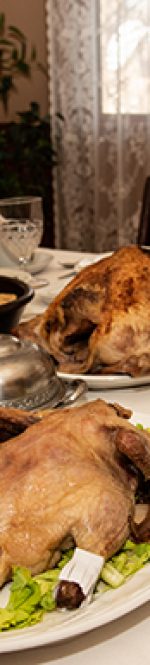
Learn about late 19th century Thanksgiving traditions as the Farm & Museum celebrates Thanksgiving Weekend, Friday – Sunday, November 27 – 29, from 10:00 a.m. to 4:00 p.m. Discover how Thanksgiving was observed at the Billings Farm in the 1890s. The event will feature the traditional farmhouse Thanksgiving table setting, holiday programs and activities. Find out the history of foods typically served on the Farm for this holiday. Share stories about your own family traditions on our “Sharing Wall.” See why we are thankful for the stewardship of this land and take a “Thankfulness Walk” around the farm. Families will also enjoy holiday-themed children’s stories in the Theater and the “Story Walk” along the pastures. Children can take home a seasonal “to-go” craft bag with instructions and materials to make a colorful ear of corn or a pumpkin out of beads.
The Farm & Museum is open weekends and vacation weeks November – February, from 10:00 am – 4:00 pm or online anytime at billingsfarm.org/billings-farm-at-home/.
Note that as of July 1, the Billings Farm & Museum site is limited to a maximum capacity of 225 people at one time, per State of Vermont guidance, and face coverings must be worn by all guests over the age of 2 everywhere on the site, including the outdoors. For more about visiting Billings Farm safely, updates on our site capacity, and to learn which spaces are open, visit billingsfarm.org/safety/.
The Billings Farm & Museum is owned and operated by The Woodstock Foundation Inc., a charitable non-profit institution. Billings Farm & Museum is committed to providing educational opportunities and experiences to our visitors, whether here in Woodstock, Vermont or at home wherever you are through our online resources at Billings Farm at Home. Admission rates, hours, and a schedule of events and activities can be found by visiting billingsfarm.org.
PHOTO COURTESY OF BILLINGS FARM & MUSEUM
This school year, Billings Farm in Woodstock is offering young home-schoolers and remote learners a course that challenges them to “Think Like A Farmer.”
Billings Farm is an operating Jersey dairy farm with a museum of Vermont’s rural past, and VPR spoke with interpretation and education coordinator Christine Scales about the four-week class.
The curriculum is set up to give 7- to 12-year-olds a prompt, like ‘design a way to water your plants,’ or ‘create an invention to feed certain animals on the farm,’ and then to have them problem-solve in ways that farmers have been doing for hundreds and even thousands of years.
“Farmers really have to be mechanics. They have to be engineers,” Scales said. “They have to understand how weather works. They have to understand physics.”
She added that the students will be asked to create contraptions, perhaps using inspiration from the old tools and technologies on display in the Billings exhibit. She also said it’s an opportuniy to introduce kids to the STEAM fields: science, technology, engineering, art and math.
The farm offers classes for older learners, too, in its Billings Backyard series.
You can listen to the recording on the VPR.org website: click here
WOODSTOCK, VERMONT… Billings Farm & Museum will host A Family Halloween on Sunday, October 25, from 10:00 a.m. until 4:00 p.m. Children in costume receive free admission when accompanied by a ticketed adult.
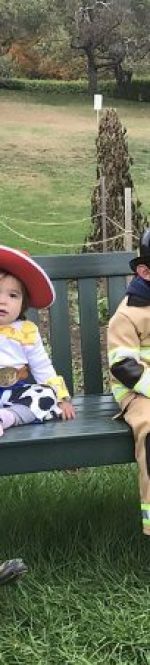
Children are invited to march in a costume parade. Parades will be held at 11:30 & 1:30 p.m., and all children will receive a ribbon. Costumed children can enter to win a drawing for a $10 gift certificate to the Museum Shop. Drawings will be held following each costume parade. Families can also enjoy a hayride around the farm, offered from 11:00 a.m. – 3:00 p.m.
Activities for all ages include pumpkin bowling, making spider web necklaces, plus family-friendly Halloween story readings. Families can venture through the “not too spooky” Farm Life Exhibits while searching for the hidden pumpkins. Children are invited to trick-or-treat safely from 12:00 – 3:00 p.m. at candy stations located around the farm.
Don’t fear the annual pumpkin carving contest! Guests vote for their favorite in the ‘spooktastic” display of decorated pumpkins created by our staff! See the roasted pumpkin seed display and take home the Billings Farm recipe.
Visit the Dairy Bar for a special fall treat – cider and doughnuts! Also available: pumpkin ice cream and Billings Farm cheese.
Note that as of July 1, the Billings Farm & Museum site is limited to a maximum capacity of 225 people at one time, per State of Vermont guidance, and face coverings must be worn by all guests over the age of 2 everywhere on the site, including the outdoors. For more about visiting Billings Farm safely, updates on our site capacity, and to learn which spaces are open, visit billingsfarm.org/safety/.
The Farm & Museum is open Thursdays-Tuesdays, from 10:00 am - 4:00 pm through Oct. 31, November – February weekends and vacation weeks or online anytime at billingsfarm.org/billings-farm-at-home/.
The Billings Farm & Museum is owned and operated by The Woodstock Foundation Inc., a charitable non-profit institution. Billings Farm & Museum is committed to providing educational opportunities and experiences to our visitors, whether here in Woodstock, Vermont or at home wherever you are through our online resources at Billings Farm at Home. Admission rates, hours, and a schedule of events and activities can be found by visiting billingsfarm.org.
PHOTO COURTESY OF BILLINGS FARM & MUSEUM
BURLINGTON, Vt. (WCAX) – When the virus shuttered many Vermont storefronts and activities, Vermonters stepped up to find creative ways to provide their services, while doing it safely.
This time, it brings a new app to your app store, but only for a limited time!
While a US Passport isn’t going to do you much good with travel restrictions at the moment, soon there will be a virtual passport, perfect for exploring the Green Mountain State.
“It’s a digital passport, so the goal is for people to download our game. They can go to every attraction and scan their QR code and they get points for every attraction they visit. And we’ll have a big prize package for people who win the most points throughout the game,” says Kristin Bogovich of the Vermont Attractions Association.
The Vermont Attractions Association launches their digital Passport App on Monday, October 12th, thanks to $10,000 in microgrants from Restart Vermont.
The goal is to bring more foot traffic to our state’s unique attractions.
“You know, the attraction industry was really really hard hit. It goes hand in hand with the tourism industry. We all lost visitors from all over, we lost them all throughout the summer, the pandemic has hit us for the entirety of our seasons. So our goal is to get people to every corner of the state to experience all of these attractions and to just enjoy places maybe they didn’t know about,” says Bogovich.
Billings Farm and Museum in Woodstock is one of more than 50 attractions on the passport, like maple houses, the ECHO Leahy Center, and the Spirit of Ethan Allen.
“I think it’s a wonderful program that offers visitors the opportunity to engage with Vermont’s spectacular array of attractions and we’re pleased to be among them,” says David Simmons, executive director of Billings Farm and Museum.
Established in 1871, Billings Farm is open year round, and represents the history of farming in Vermont.
Usually, this operational dairy farm brings in around 60,000 visitors a year, with many on tour buses.
This year, they’re at about 50 percent of that.
“But what’s rewarding is that we’ve been able to provide a wonderful experience for those who have come, with a very strict set of safety protocols both for our guests and for our staff,” says Simmons.
Simmons says they’ve taken physical distancing very seriously and are excited to welcome guests using the passport, which is good until November.
“One of the things that we offer is a largely outdoor experience. Our sense is that Vermonters and others who have spent time with us this year have been hungry for a chance to get out of the house with the family in a safe environment and enjoy some of the best that Vermont has to offer,” he says.
To do it, scan this QR code starting October 12th.